


Page 44 - Policy Economic Report - October 2026
P. 44
POLICY AND ECONOMIC
              OIL & GAS MARKET

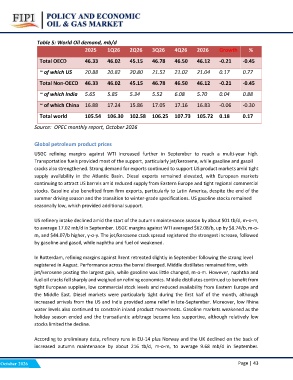
              Table 5: World Oil demand, mb/d                         Growth  %
                                       2025 1Q26 2Q26 3Q26 4Q26 2026

              Total OECD   46.33 46.02 45.15 46.78 46.50 46.12 -0.21 -0.45

              ~ of which US 20.88 20.82 20.80 21.52 21.02 21.04 0.17 0.77

              Total Non-OECD 46.33 46.02 45.15 46.78 46.50 46.12 -0.21 -0.45

              ~ of which India 5.65 5.85 5.34 5.52 6.08 5.70 0.04 0.88

              ~ of which China 16.88 17.24 15.86 17.05 17.16 16.83 -0.06 -0.30

              Total world  105.54 106.30 102.58 106.25 107.73 105.72 0.18 0.17

              Source: OPEC monthly report, October 2026

              Global petroleum product prices

              USGC refining margins against WTI increased further in September to reach a multi-year high.
              Transportation fuels provided most of the support, particularly jet/kerosene, while gasoline and gasoil
              cracks also strengthened. Strong demand for exports continued to support US product markets amid tight
              supply availability in the Atlantic Basin. Diesel exports remained elevated, with European markets
              continuing to attract US barrels amid reduced supply from Eastern Europe and tight regional commercial
              stocks. Gasoline also benefited from firm exports, particularly to Latin America, despite the end of the
              summer driving season and the transition to winter-grade specifications. US gasoline stocks remained
              seasonally low, which provided additional support.

              US refinery intake declined amid the start of the autumn maintenance season by about 501 tb/d, m-o-m,
              to average 17.02 mb/d in September. USGC margins against WTI averaged $62.08/b, up by $8.74/b, m-o-
              m, and $44.07/b higher, y-o-y. The jet/kerosene crack spread registered the strongest increase, followed
              by gasoline and gasoil, while naphtha and fuel oil weakened.

              In Rotterdam, refining margins against Brent retreated slightly in September following the strong level
              registered in August. Performance across the barrel diverged. Middle distillates remained firm, with
              jet/kerosene posting the largest gain, while gasoline was little changed, m-o-m. However, naphtha and
              fuel oil cracks fell sharply and weighed on refining economics. Middle distillates continued to benefit from
              tight European supplies, low commercial stock levels and reduced availability from Eastern Europe and
              the Middle East. Diesel markets were particularly tight during the first half of the month, although
              increased arrivals from the US and India provided some relief in late-September. Moreover, low Rhine
              water levels also continued to constrain inland product movements. Gasoline markets weakened as the
              holiday season ended and the transatlantic arbitrage became less supportive, although relatively low
              stocks limited the decline.

              According to preliminary data, refinery runs in EU-14 plus Norway and the UK declined on the back of
              increased autumn maintenance by about 216 tb/d, m-o-m, to average 9.68 mb/d in September.

October 2026                                                                  Page | 43

