


Page 21 - Policy & Economic Report - July 2025
P. 21
POLICY AND ECONOMIC
               ROEILPO&RGTAS MARKET

           per cent in FY 2026–27, compared with 7.7 per cent in FY 2025–26, before improving modestly to 6.8 per
           cent in FY 2027–28. While the projected slowdown reflects a more challenging global environment, India's
           growth outlook continues to compare favourably with that of other major economies, supported by
           resilient domestic demand, sound macroeconomic fundamentals and continued policy support.

           The anticipated moderation in growth is primarily attributed to subdued private investment, elevated
           global crude oil prices and increasing external uncertainties arising from ongoing geopolitical tensions in
           the Middle East. Higher energy prices are expected to raise production costs, exert upward pressure on
           inflation and moderate domestic demand, particularly in an economy that remains heavily dependent on
           imported crude oil. At the same time, cautious private sector capital expenditure amid global uncertainty
           may constrain the pace of employment generation and investment-led expansion.

           Inflation in India

           Retail inflation in India increased during June 2026, primarily driven by a rise in food prices, while inflation
           across most non-food categories remained relatively moderate. Although headline inflation moved closer
           to the Reserve Bank of India's target level, underlying price pressures continued to remain uneven across
           expenditure groups, with food and select services contributing significantly to the overall increase. The
           latest Consumer Price Index (CPI) data indicate that inflationary pressures were largely food-led rather
           than broad-based, reflecting the continued resilience of core inflation.

           National Level Indices
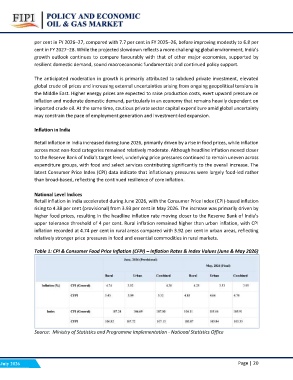
           Retail inflation in India accelerated during June 2026, with the Consumer Price Index (CPI)-based inflation
           rising to 4.38 per cent (provisional) from 3.93 per cent in May 2026. The increase was primarily driven by
           higher food prices, resulting in the headline inflation rate moving closer to the Reserve Bank of India's
           upper tolerance threshold of 4 per cent. Rural inflation remained higher than urban inflation, with CPI
           inflation recorded at 4.74 per cent in rural areas compared with 3.92 per cent in urban areas, reflecting
           relatively stronger price pressures in food and essential commodities in rural markets.

           Table 1: CPI & Consumer Food Price Inflation (CFPI) – Inflation Rates & Index Values (June & May 2026)

           Source: Ministry of Statistics and Programme Implementation - National Statistics Office

July 2026                                                                                            Page | 20

