


Page 56 - Policy & Economic Report - July 2025
P. 56
POLICY AND ECONOMIC
           ROEILPO&RGTAS MARKET

           According to SIAM and ARAI, E20 improves acceleration and ride quality while reducing carbon
           emissions. Ethanol's higher-octane number supports modern high-compression engines and its higher
           heat of vaporisation improves combustion efficiency.

           5. Facts about Ethanol Blended Petrol: Separating Facts from Misconceptions
               PIB in its report has brought out certain misleading claims regarding the Ethanol Blended Petrol (EBP)
               Programme that have recently been circulated in the media and on social media. The following point-
               wise clarifications, based on scientific validation, extensive field experience and industry data, address
               these claims and present the factual position.

           Claim 1: Vehicles manufactured before 2023 cannot run on E20 petrol.

           • E15-plus fuel has been in widespread use for over three and a half years, while E19-E20 fuel
               has been in use for over two and a half years.

           • During this period, no verified news of widespread engine failure or vehicle breakdown
               attributable to ethanol blending has emerged. Had ethanol blending been causing systemic
               damage to engines or fuel systems, such failures would have resulted in large-scale warranty
               claims, service campaigns and widespread consumer complaints, none of which have been
               reported.

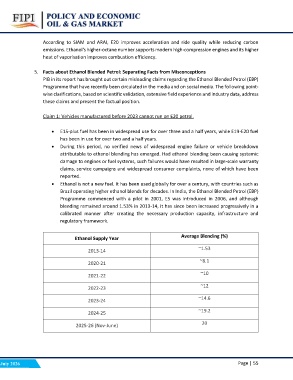
           • Ethanol is not a new fuel. It has been used globally for over a century, with countries such as
               Brazil operating higher ethanol blends for decades. In India, the Ethanol Blended Petrol (EBP)
               Programme commenced with a pilot in 2001, E5 was introduced in 2006, and although
               blending remained around 1.53% in 2013-14, it has since been increased progressively in a
               calibrated manner after creating the necessary production capacity, infrastructure and
               regulatory framework.

           Ethanol Supply Year   Average Blending (%)
                  2013-14                 ~1.53
                  2020-21                  ~8.1
                  2021-22                   ~10
                  2022-23                   ~12
                  2023-24                 ~14.6
                  2024-25                 ~19.2
                                            20
           2025-26 (Nov-June)

July 2026                                                                        Page | 55

