


Page 43 - FIPI - Policy & Economic Report May 2026
P. 43
POLICY AND ECONOMIC REPORT
          OIL & GAS MARKET

          Oil demand situation

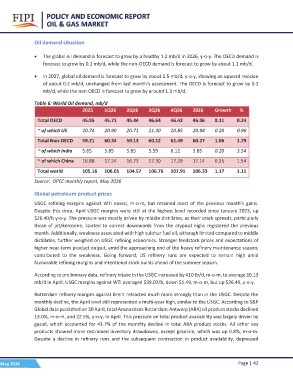
          ? The global oil demand is forecast to grow by a healthy 1.2 mb/d in 2026, y-o-y. The OECD demand is
              forecast to grow by 0.1 mb/d, while the non-OECD demand is forecast to grow by about 1.1 mb/d.

          ? In 2027, global oil demand is forecast to grow by about 1.5 mb/d, y-o-y, showing an upward revision
              of about 0.2 mb/d, unchanged from last month’s assessment. The OECD is forecast to grow by 0.2
              mb/d, while the non-OECD is forecast to grow by around 1.3 mb/d.

          Table 6: World Oil demand, mb/d        2Q26  3Q26    4Q26    2026    Growth %
                                     2025 1Q26         46.64   46.42   46.06   0.11 0.24
                                                       21.30   20.85   20.94   0.20 0.96
          Total OECD     45.95 45.71 45.44             60.12   61.49   60.27   1.06 1.79
                                                       5.59    6.12    5.85    0.20 3.54
          ~ of which US  20.74 20.90 20.71             17.30   17.29   17.14   0.25 1.54
                                                       106.76  107.91  106.33  1.17 1.11
          Total Non-OECD 59.21 60.34 59.13

          ~ of which India 5.65 5.85 5.85

          ~ of which China 16.88 17.24 16.73

          Total world    105.16 106.05 104.57

          Source: OPEC monthly report, May 2026

          Global petroleum product prices

          USGC refining margins against WTI eased, m-o-m, but retained most of the previous month’s gains.
          Despite this drop, April USGC margins were still at the highest level recorded since January 2023, up
          $26.40/b y-o-y. The pressure was mostly driven by middle distillates, as their crack spreads, particularly
          those of jet/kerosene, started to correct downwards from the atypical highs registered the previous
          month. Additionally, weakness associated with high sulphur fuel oil, although limited compared to middle
          distillates, further weighed on USGC refining economics. Stronger feedstock prices and expectations of
          higher near-term product output, amid the approaching end of the heavy refinery maintenance season,
          contributed to the weakness. Going forward, US refinery runs are expected to remain high amid
          favourable refining margins and intentional stock builds ahead of the summer season.

          According to preliminary data, refinery intake in the USGC increased by 410 tb/d, m-o-m, to average 16.13
          mb/d in April. USGC margins against WTI averaged $39.02/b, down $1.49, m-o-m, but up $26.40, y-o-y.

          Rotterdam refinery margins against Brent retracted much more strongly than in the USGC. Despite the
          monthly decline, the April level still represented a multi-year high, similar to the USGC. According to S&P
          Global data published on 30 April, total Amsterdam-Rotterdam-Antwerp (ARA) oil product stocks declined
          13.0%, m-o-m, and 22.5%, y-o-y, in April. This pressure on total product availability was largely driven by
          gasoil, which accounted for 43.7% of the monthly decline in total ARA product stocks. All other key
          products showed more restrained inventory drawdowns, except gasoline, which was up 0.8%, m-o-m.
          Despite a decline in refinery runs and the subsequent contraction in product availability, depressed

May 2026                                                                       Page | 42

