


Page 17 - Policy Economic Report - October 2026
P. 17
POLICY AND ECONOMIC
                  OIL & GAS MARKET

              Global headline inflation rose in August as energy prices rebounded following a short-lived ceasefire in
              the Middle East, according to the IMF. Core inflation has so far remained moderate, although core-goods
              prices in some advanced economies have begun to reflect the rapidly rising cost of memory chips, and US
              core inflation increased, driven mainly by a rebound in travel-services prices. The IMF also cautions that
              the AI investment boom is adding to demand pressures in economies operating near capacity, which could
              strengthen the pass-through from headline to core inflation.

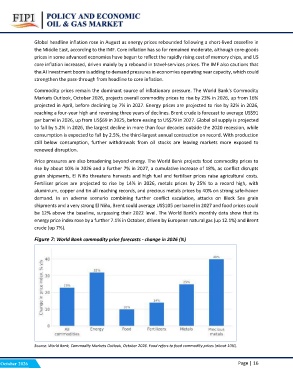
              Commodity prices remain the dominant source of inflationary pressure. The World Bank's Commodity
              Markets Outlook, October 2026, projects overall commodity prices to rise by 23% in 2026, up from 16%
              projected in April, before declining by 7% in 2027. Energy prices are projected to rise by 32% in 2026,
              reaching a four-year high and reversing three years of declines. Brent crude is forecast to average US$91
              per barrel in 2026, up from US$69 in 2025, before easing to US$79 in 2027. Global oil supply is projected
              to fall by 5.2% in 2026, the largest decline in more than four decades outside the 2020 recession, while
              consumption is expected to fall by 2.5%, the third-largest annual contraction on record. With production
              still below consumption, further withdrawals from oil stocks are leaving markets more exposed to
              renewed disruption.

              Price pressures are also broadening beyond energy. The World Bank projects food commodity prices to
              rise by about 10% in 2026 and a further 7% in 2027, a cumulative increase of 18%, as conflict disrupts
              grain shipments, El Niño threatens harvests and high fuel and fertiliser prices raise agricultural costs.
              Fertiliser prices are projected to rise by 14% in 2026, metals prices by 25% to a record high, with
              aluminium, copper and tin all reaching records, and precious metals prices by 40% on strong safe-haven
              demand. In an adverse scenario combining further conflict escalation, attacks on Black Sea grain
              shipments and a very strong El Niño, Brent could average US$105 per barrel in 2027 and food prices could
              be 12% above the baseline, surpassing their 2022 level. The World Bank's monthly data show that its
              energy price index rose by a further 7.1% in October, driven by European natural gas (up 12.1%) and Brent
              crude (up 7%).

              Figure 7: World Bank commodity price forecasts - change in 2026 (%)

              Source: World Bank, Commodity Markets Outlook, October 2026. Food refers to food commodity prices (about 10%).

October 2026                                                                                                                  Page | 16

