


Page 12 - Policy Economic Report - October 2026
P. 12
POLICY AND ECONOMIC
                  OIL & GAS MARKET

              The IMF's baseline rests on several key assumptions. The Strait of Hormuz is assumed to begin reopening
              in March 2027, with a broad return to pre-war conditions by October 2027. The average oil price (a simple
              average of Brent, Dubai Fateh and WTI) is assumed at US$95.74 per barrel in 2026 and US$87.39 in 2027,
              compared with US$67.74 in 2025, implying a 41% rise in crude oil prices in 2026. Natural gas prices (TTF)
              are assumed at about US$20/MMBtu, 48% higher than in 2025, while fertiliser prices are projected to rise
              by 10% and food prices by 5%. Monetary policy is expected to be less supportive than assumed in April,
              and public debt is projected to keep rising, from 108% to 115% of GDP in advanced economies and from
              74% to 84% of GDP in emerging market and developing economies between 2025 and 2031.

              High-frequency indicators confirm that near-term momentum remains firm, though it eased at the start
              of the fourth quarter. S&P Global Market Intelligence raised its 2026 global growth forecast to 2.6% in
              October, narrowing the gap with its pre-conflict estimate of 2.9% made in February, as the global economy
              proved more resilient than expected. It estimates US real GDP growth close to 4% (annualised) in the third
              quarter and world trade volumes up more than 7% year-on-year in the third quarter to date, the strongest
              since 2021. However, S&P Global lowered its 2027 forecasts for most major economies, citing broadening
              commodity-price pressures, higher expected inflation and less favourable financial conditions.

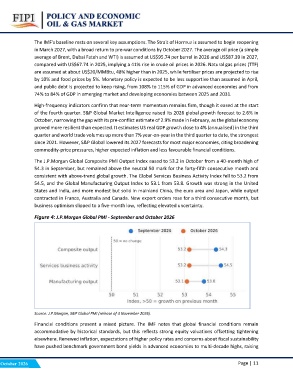
              The J.P.Morgan Global Composite PMI Output Index eased to 53.2 in October from a 40-month high of
              54.3 in September, but remained above the neutral 50 mark for the forty-fifth consecutive month and
              consistent with above-trend global growth. The Global Services Business Activity Index fell to 53.2 from
              54.5, and the Global Manufacturing Output Index to 53.1 from 53.8. Growth was strong in the United
              States and India, and more modest but solid in mainland China, the euro area and Japan, while output
              contracted in France, Australia and Canada. New export orders rose for a third consecutive month, but
              business optimism slipped to a five-month low, reflecting elevated uncertainty.

              Figure 4: J.P.Morgan Global PMI - September and October 2026

              Source: J.P.Morgan, S&P Global PMI (release of 4 November 2026).

              Financial conditions present a mixed picture. The IMF notes that global financial conditions remain
              accommodative by historical standards, but this reflects strong equity valuations offsetting tightening
              elsewhere. Renewed inflation, expectations of higher policy rates and concerns about fiscal sustainability
              have pushed benchmark government bond yields in advanced economies to multi-decade highs, raising

October 2026  Page | 11

