


Page 16 - Policy Economic Report - October 2026
P. 16
POLICY AND ECONOMIC
    OIL & GAS MARKET

Growth in sub-Saharan Africa is projected to remain stable at 4.5% in 2026 and 2027, although oil-
importing, non-resource-intensive economies are more adversely affected by higher energy and food
prices. Nigeria is projected to grow by 4.2% in 2026, supported by improved macroeconomic stability and
favourable terms of trade, while South Africa's growth is projected at 1.0%. In Latin America and the
Caribbean, growth is projected to edge down to 2.3% in 2026 before picking up to 2.5% in 2027. Brazil's
growth is expected to slow from 2.2% in 2026 to 1.9% in 2027 amid still-restrictive monetary conditions,
while Mexico is projected to accelerate from 1.5% to 1.8%, supported in part by exports linked to AI value
chains. In emerging and developing Europe, growth is projected to slow to 1.7% in 2026 before recovering
to 2.1% in 2027, with Russia at 0.9%.

UNCTAD cautions that the gap between fast-growing and struggling developing economies is widening
sharply. It projects growth in developing economies as a whole to slow from 4.7% in 2025 to 4.0% in 2026,
and notes that income convergence with advanced economies has stalled across most of the developing
world since the mid-2010s. Official development assistance, a key source of finance for the least
developed countries and small island developing states, is projected to fall by almost 7% in 2026, its third
consecutive annual decline.

Global Inflation Trends

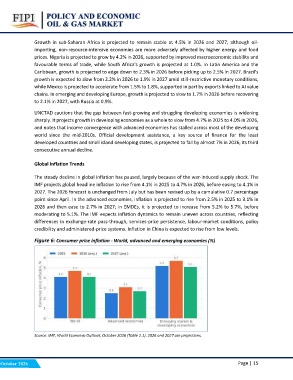
The steady decline in global inflation has paused, largely because of the war-induced supply shock. The
IMF projects global headline inflation to rise from 4.1% in 2025 to 4.7% in 2026, before easing to 4.1% in
2027. The 2026 forecast is unchanged from July but has been revised up by a cumulative 0.7 percentage
point since April. In the advanced economies, inflation is projected to rise from 2.5% in 2025 to 3.1% in
2026 and then ease to 2.7% in 2027; in EMDEs, it is projected to increase from 5.2% to 5.7%, before
moderating to 5.1%. The IMF expects inflation dynamics to remain uneven across countries, reflecting
differences in exchange-rate pass-through, services-price persistence, labour-market conditions, policy
credibility and administered-price systems. Inflation in China is expected to rise from low levels.

Figure 6: Consumer price inflation - World, advanced and emerging economies (%)

                       Source: IMF, World Economic Outlook, October 2026 (Table 1.1). 2026 and 2027 are projections.  Page | 15
October 2026

