


Page 10 - Policy Economic Report -August 2026
P. 10
POLICY AND ECONOMIC
                 OIL & GAS MARKET

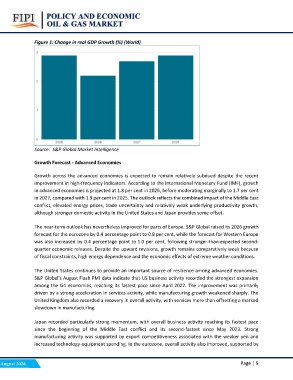
             Figure 1: Change in real GDP Growth (%) (World)

             Source: S&P Global Market Intelligence

             Growth Forecast - Advanced Economies

             Growth across the advanced economies is expected to remain relatively subdued despite the recent
             improvement in high-frequency indicators. According to the International Monetary Fund (IMF), growth
             in advanced economies is projected at 1.8 per cent in 2026, before moderating marginally to 1.7 per cent
             in 2027, compared with 1.9 per cent in 2025. The outlook reflects the combined impact of the Middle East
             conflict, elevated energy prices, trade uncertainty and relatively weak underlying productivity growth,
             although stronger domestic activity in the United States and Japan provides some offset.

             The near-term outlook has nevertheless improved for parts of Europe. S&P Global raised its 2026 growth
             forecast for the eurozone by 0.4 percentage point to 0.8 per cent, while the forecast for Western Europe
             was also increased by 0.4 percentage point to 1.0 per cent, following stronger-than-expected second-
             quarter economic releases. Despite the upward revisions, growth remains comparatively weak because
             of fiscal constraints, high energy dependence and the economic effects of extreme weather conditions.

             The United States continues to provide an important source of resilience among advanced economies.
             S&P Global's August Flash PMI data indicate that US business activity recorded the strongest expansion
             among the G4 economies, reaching its fastest pace since April 2022. The improvement was primarily
             driven by a strong acceleration in services activity, while manufacturing growth weakened sharply. The
             United Kingdom also recorded a recovery in overall activity, with services more than offsetting a marked
             slowdown in manufacturing.

             Japan recorded particularly strong momentum, with overall business activity reaching its fastest pace
             since the beginning of the Middle East conflict and its second-fastest since May 2023. Strong
             manufacturing activity was supported by export competitiveness associated with the weaker yen and
             increased technology-equipment spending. In the eurozone, overall activity also improved, supported by

August 2026                                                   Page | 9

