


Page 13 - Policy Economic Report -August 2026
P. 13
POLICY AND ECONOMIC
                 OIL & GAS MARKET

             Inflation developments also varied considerably across major economies. The United States recorded the
             sharpest increase in selling prices among the major advanced economies in July, with services inflation
             reaching a 14-month high. Japan also experienced a significant increase in price pressures, while inflation
             moderated in the eurozone and United Kingdom as energy prices eased. Among major emerging
             economies, Brazil continued to record the highest inflation rate, although price growth moderated, while
             mainland China's inflation pressures remained comparatively weak.

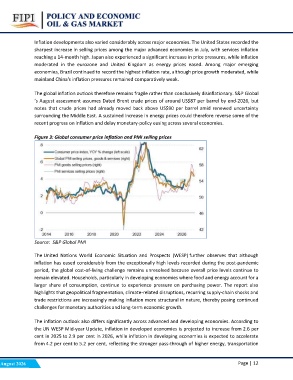
             The global inflation outlook therefore remains fragile rather than conclusively disinflationary. S&P Global
             ‘s August assessment assumes Dated Brent crude prices of around US$87 per barrel by end-2026, but
             notes that crude prices had already moved back above US$90 per barrel amid renewed uncertainty
             surrounding the Middle East. A sustained increase in energy prices could therefore reverse some of the
             recent progress on inflation and delay monetary-policy easing across several economies.

             Figure 3: Global consumer price inflation and PMI selling prices

             Source: S&P Global PMI

             The United Nations World Economic Situation and Prospects (WESP) further observes that although
             inflation has eased considerably from the exceptionally high levels recorded during the post-pandemic
             period, the global cost-of-living challenge remains unresolved because overall price levels continue to
             remain elevated. Households, particularly in developing economies where food and energy account for a
             larger share of consumption, continue to experience pressure on purchasing power. The report also
             highlights that geopolitical fragmentation, climate-related disruptions, recurring supply-chain shocks and
             trade restrictions are increasingly making inflation more structural in nature, thereby posing continued
             challenges for monetary authorities and long-term economic growth.

             The inflation outlook also differs significantly across advanced and developing economies. According to
             the UN WESP Mid-year Update, inflation in developed economies is projected to increase from 2.6 per
             cent in 2025 to 2.9 per cent in 2026, while inflation in developing economies is expected to accelerate
             from 4.2 per cent to 5.2 per cent, reflecting the stronger pass-through of higher energy, transportation

August 2026  Page | 12

