


Page 10 - Policy & Economic Report - July 2025
P. 10
POLICY AND ECONOMIC
               ROEILPO&RGTAS MARKET

           Global trade continued to expand during the first half of 2026 despite rising geopolitical tensions.
           According to UN Trade and Development (UNCTAD), global goods trade reached approximately US$13.7
           trillion, registering a 12.5 per cent increase over the corresponding period of 2025, while services trade
           expanded by 10.5 per cent. Trade growth remained strongest in East Asia, supported by sustained
           demand for semiconductors, AI-related products, electrical machinery, batteries and electric vehicle
           components. However, a significant portion of the increase reflected higher trade prices resulting from
           elevated energy, transport and logistics costs rather than stronger trade volumes. Looking ahead,
           geopolitical uncertainty, evolving trade policies, shipping disruptions and increasing geoeconomic
           fragmentation are expected to make global trade growth more uneven across regions and sectors.

           Overall, the global economy continues to demonstrate resilience despite an increasingly uncertain
           external environment. While easing commodity prices, resilient labour markets and continued investment
           in artificial intelligence are supporting economic activity, persistent geopolitical tensions, energy market
           volatility, elevated public debt, weakening investment momentum and trade fragmentation remain
           significant downside risks. The trajectory of global growth during the remainder of 2026 will largely
           depend on developments in the Middle East conflict, stability in energy markets, the pace of disinflation,
           central bank policy responses and the continued strength of technology-led investment and global trade.

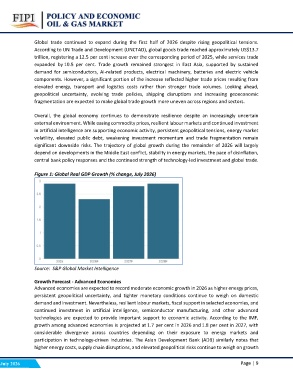
           Figure 1: Global Real GDP Growth (% change, July 2026)

July 2026  Source: S&P Global Market Intelligence

           Growth Forecast - Advanced Economies
           Advanced economies are expected to record moderate economic growth in 2026 as higher energy prices,
           persistent geopolitical uncertainty, and tighter monetary conditions continue to weigh on domestic
           demand and investment. Nevertheless, resilient labour markets, fiscal support in selected economies, and
           continued investment in artificial intelligence, semiconductor manufacturing, and other advanced
           technologies are expected to provide important support to economic activity. According to the IMF,
           growth among advanced economies is projected at 1.7 per cent in 2026 and 1.8 per cent in 2027, with
           considerable divergence across countries depending on their exposure to energy markets and
           participation in technology-driven industries. The Asian Development Bank (ADB) similarly notes that
           higher energy costs, supply chain disruptions, and elevated geopolitical risks continue to weigh on growth

                                                                                                                                 Page | 9

