


Page 13 - Policy & Economic Report - July 2025
P. 13
POLICY AND ECONOMIC
               ROEILPO&RGTAS MARKET

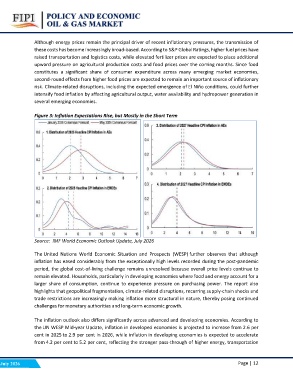
           Although energy prices remain the principal driver of recent inflationary pressures, the transmission of
           these costs has become increasingly broad-based. According to S&P Global Ratings, higher fuel prices have
           raised transportation and logistics costs, while elevated fertilizer prices are expected to place additional
           upward pressure on agricultural production costs and food prices over the coming months. Since food
           constitutes a significant share of consumer expenditure across many emerging market economies,
           second-round effects from higher food prices are expected to remain an important source of inflationary
           risk. Climate-related disruptions, including the expected emergence of El Niño conditions, could further
           intensify food inflation by affecting agricultural output, water availability and hydropower generation in
           several emerging economies.

           Figure 3: Inflation Expectations Rise, but Mostly in the Short Term

           Source: IMF World Economic Outlook Update, July 2026

           The United Nations World Economic Situation and Prospects (WESP) further observes that although
           inflation has eased considerably from the exceptionally high levels recorded during the post-pandemic
           period, the global cost-of-living challenge remains unresolved because overall price levels continue to
           remain elevated. Households, particularly in developing economies where food and energy account for a
           larger share of consumption, continue to experience pressure on purchasing power. The report also
           highlights that geopolitical fragmentation, climate-related disruptions, recurring supply-chain shocks and
           trade restrictions are increasingly making inflation more structural in nature, thereby posing continued
           challenges for monetary authorities and long-term economic growth.

           The inflation outlook also differs significantly across advanced and developing economies. According to
           the UN WESP Mid-year Update, inflation in developed economies is projected to increase from 2.6 per
           cent in 2025 to 2.9 per cent in 2026, while inflation in developing economies is expected to accelerate
           from 4.2 per cent to 5.2 per cent, reflecting the stronger pass-through of higher energy, transportation

July 2026  Page | 12

