


Page 14 - Policy & Economic Report - July 2025
P. 14
POLICY AND ECONOMIC
               ROEILPO&RGTAS MARKET

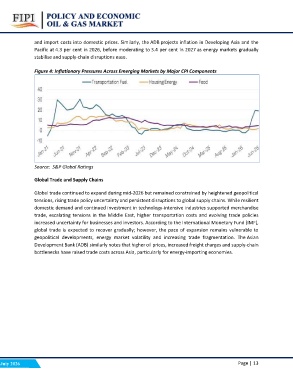
           and import costs into domestic prices. Similarly, the ADB projects inflation in Developing Asia and the
           Pacific at 4.3 per cent in 2026, before moderating to 3.4 per cent in 2027 as energy markets gradually
           stabilise and supply-chain disruptions ease.
           Figure 4: Inflationary Pressures Across Emerging Markets by Major CPI Components

           Source: S&P Global Ratings
           Global Trade and Supply Chains
           Global trade continued to expand during mid-2026 but remained constrained by heightened geopolitical
           tensions, rising trade policy uncertainty and persistent disruptions to global supply chains. While resilient
           domestic demand and continued investment in technology-intensive industries supported merchandise
           trade, escalating tensions in the Middle East, higher transportation costs and evolving trade policies
           increased uncertainty for businesses and investors. According to the International Monetary Fund (IMF),
           global trade is expected to recover gradually; however, the pace of expansion remains vulnerable to
           geopolitical developments, energy market volatility and increasing trade fragmentation. The Asian
           Development Bank (ADB) similarly notes that higher oil prices, increased freight charges and supply-chain
           bottlenecks have raised trade costs across Asia, particularly for energy-importing economies.

July 2026  Page | 13

