


Page 10 - Policy Economic Report - October 2026
P. 10
POLICY AND ECONOMIC
                  OIL & GAS MARKET

              momentum in Spain. Japan's second-quarter outcome was better than expected, and India's growth
              remained robust, supported by domestic demand and services despite higher oil prices. China's second-
              quarter growth, by contrast, was weaker than expected at 4.3% year-on-year, as subdued consumption
              and weakening investment amid property-sector strains were only partly offset by strong exports.

              The IMF attributes the resilience of the global economy primarily to the flexibility of energy supply. The
              closure of the Strait of Hormuz disrupted a route that carried about 20 million barrels of oil per day before
              the war, roughly a quarter of the world's maritime oil trade. However, Gulf producers redirected part of
              their supply to other ports, production outside the Gulf rose by about 2 million barrels per day, and the
              release of global inventories provided a further 4 million barrels per day. Even so, balancing the market
              at higher prices required demand compression of about 5 million barrels per day in the second quarter of
              2026. China, the world's largest oil importer, absorbed a significant part of the adjustment, reducing crude
              oil imports by 23% year-on-year between March and June 2026 through inventory drawdowns and lower
              refined-oil consumption.

              Structural changes in energy use have also reduced the global economy's sensitivity to oil-price shocks.
              Energy use per dollar of global GDP has fallen by 32% over the past two decades, and renewable sources
              have accounted for 60% of the total increase in global electricity generation since 2010. IMF model-based
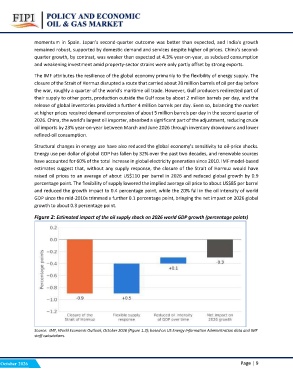
              estimates suggest that, without any supply response, the closure of the Strait of Hormuz would have
              raised oil prices to an average of about US$110 per barrel in 2026 and reduced global growth by 0.9
              percentage point. The flexibility of supply lowered the implied average oil price to about US$85 per barrel
              and reduced the growth impact to 0.4 percentage point, while the 20% fall in the oil intensity of world
              GDP since the mid-2010s trimmed a further 0.1 percentage point, bringing the net impact on 2026 global
              growth to about 0.3 percentage point.

              Figure 2: Estimated impact of the oil supply shock on 2026 world GDP growth (percentage points)

              Source: IMF, World Economic Outlook, October 2026 (Figure 1.3); based on US Energy Information Administration data and IMF
              staff calculations.

October 2026  Page | 9

