


Page 11 - Policy Economic Report - October 2026
P. 11
POLICY AND ECONOMIC
    OIL & GAS MARKET

The second major source of support has been the investment boom in artificial intelligence (AI), which the
IMF describes as a large positive demand shock transmitted most visibly through trade. Supply of AI
hardware is highly concentrated: Taiwan Province of China and Korea account for 62% of net trade in AI-
related computing hardware, while China and the United States account for more than 75% of net imports
of such hardware in 2025 and 57% of newly built data centres since 2024. As a result, the outlook has
become bifurcated. Economies with limited exposure to the energy shock and strong participation in the
technology value chain are seeing activity hold up or strengthen, and energy exporters outside the conflict
zone are benefiting from favourable terms of trade. By contrast, energy importers with little connection
to the technology value chain, including many low-income countries, face higher import bills, exchange-
rate pressures and weaker real incomes.

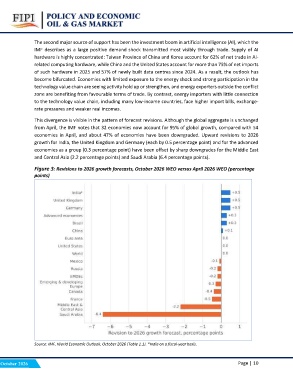
This divergence is visible in the pattern of forecast revisions. Although the global aggregate is unchanged
from April, the IMF notes that 32 economies now account for 95% of global growth, compared with 54
economies in April, and about 47% of economies have been downgraded. Upward revisions to 2026
growth for India, the United Kingdom and Germany (each by 0.5 percentage point) and for the advanced
economies as a group (0.3 percentage point) have been offset by sharp downgrades for the Middle East
and Central Asia (2.2 percentage points) and Saudi Arabia (6.4 percentage points).

Figure 3: Revisions to 2026 growth forecasts, October 2026 WEO versus April 2026 WEO (percentage
points)

                       Source: IMF, World Economic Outlook, October 2026 (Table 1.1). *India on a fiscal-year basis.  Page | 10
October 2026

