


Page 9 - Policy Economic Report - October 2026
P. 9
POLICY AND ECONOMIC
              OIL & GAS MARKET

                                          Economy in Focus

              1) Global Economic Outlook

              a) A snapshot of the global economy
              The global economy has continued to withstand the economic fallout of the war in the Middle East, but
              its resilience is increasingly uneven and is coming at a rising cost. The International Monetary Fund's World
              Economic Outlook (WEO), October 2026, titled “Resilience Under Strain, Urgent Choices” and released
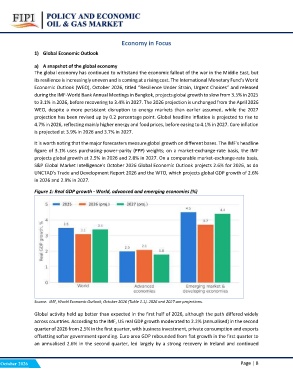
              during the IMF-World Bank Annual Meetings in Bangkok, projects global growth to slow from 3.5% in 2025
              to 3.1% in 2026, before recovering to 3.4% in 2027. The 2026 projection is unchanged from the April 2026
              WEO, despite a more persistent disruption to energy markets than earlier assumed, while the 2027
              projection has been revised up by 0.2 percentage point. Global headline inflation is projected to rise to
              4.7% in 2026, reflecting mainly higher energy and food prices, before easing to 4.1% in 2027. Core inflation
              is projected at 3.9% in 2026 and 3.7% in 2027.

              It is worth noting that the major forecasters measure global growth on different bases. The IMF's headline
              figure of 3.1% uses purchasing-power-parity (PPP) weights; on a market-exchange-rate basis, the IMF
              projects global growth at 2.5% in 2026 and 2.8% in 2027. On a comparable market-exchange-rate basis,
              S&P Global Market Intelligence's October 2026 Global Economic Outlook projects 2.6% for 2026, as do
              UNCTAD's Trade and Development Report 2026 and the WTO, which projects global GDP growth of 2.6%
              in 2026 and 2.9% in 2027.

              Figure 1: Real GDP growth - World, advanced and emerging economies (%)

              Source: IMF, World Economic Outlook, October 2026 (Table 1.1). 2026 and 2027 are projections.

              Global activity held up better than expected in the first half of 2026, although the path differed widely
              across countries. According to the IMF, US real GDP growth moderated to 2.2% (annualised) in the second
              quarter of 2026 from 2.5% in the first quarter, with business investment, private consumption and exports
              offsetting softer government spending. Euro area GDP rebounded from flat growth in the first quarter to
              an annualised 2.6% in the second quarter, led largely by a strong recovery in Ireland and continued

October 2026                                                Page | 8

