
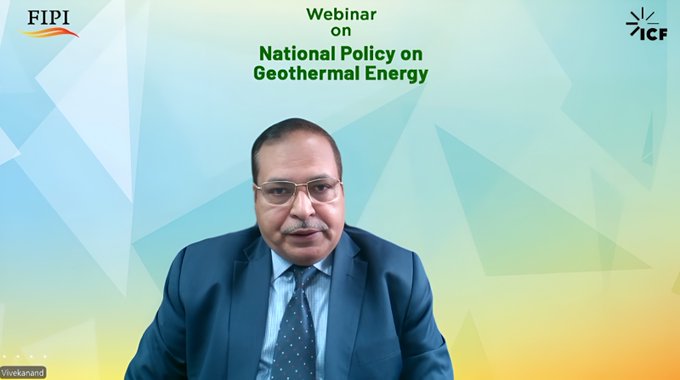
Shri Vivekanand, Director (Finance, Taxation & Legal), FIPI, in his opening remarks, welcomed the distinguished speakers from ICF and all participants
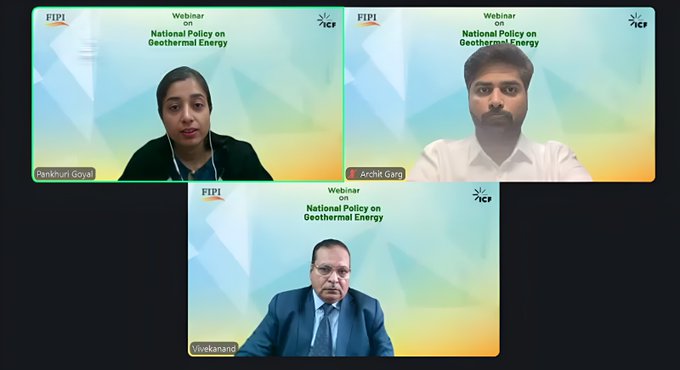
Mr. Puneet Goel, Director (Oil & Gas), and Mr. Archit Garg, Assistant Director at ICF India, shared valuable expert insights. Their detailed presentation provided participants with a comprehensive understanding of the newly launched policy, breaking down its key provisions and explaining its significance in India’s evolving clean energy landscape.
19-November-2025
Mr. Vivekanand, Director (Finance, Taxation & Legal), FIPI began the session with the opening remarks. He said that with the need to combat climate change and become environmentally sustainable, the oil and gas industry today, is transitioning towards more clean energy initiatives and opportunities. Among technologies that oil and gas companies seem particularly well-suited to capitalize on are deployment of key renewable options such as offshore wind, solar, & green hydrogen. Another such area of diversification is Geothermal energy. He said that there is strong synergy between geothermal energy and the oil and gas sector in terms of same geology, reservoir engineering, and subsurface modelling. Further, it also provides a leverage to the oil and gas players to utilize their idle/abandoned oil & gas wells. He then highlighted the global geothermal landscape mentioning the total installed capacity as 15 GW with leading countries being US, Indonesia, and the Philippines. In Iceland, geothermal energy accounts for approximately 25-30% of its total electricity generation and uses geothermal resources extensively for the purpose of space heating.
He then highlighted that the recent announced the National Policy on Geothermal Energy, 2025, is a landmark initiative designed to unlock India's vast, yet largely untapped, geothermal potential and support the nation's commitment to achieving Net Zero emissions by 2070. The policy provides a comprehensive framework to promote the exploration, development, and use of geothermal energy across various sectors. He said that the policy also offers a variety of fiscal incentives, including tax holidays and concessional loans, to encourage research and development. He said that significant potential exists for geothermal energy in the cold regions of the Himalayas and the Ladakh area, and as such the policy provides an opportunity for oil & gas companies to form joint ventures with geothermal companies and enter the geothermal space.
Mr. Archit Garg, Assistant Director, ICF in its presentation covered that the policy framework on India's national policy on geothermal energy introduces various enabling instruments such as viability gap funding, physical incentives, land and tenure clarity, and a streamlined permit pathway, which includes, exploration permits up to lease time of 30 years. States have been empowered to enable single window clearances and there is a 100% foreign direct investment allowance being provided. He highlighted that geothermal energy provides a 24/7 domestic baseload capacity and ensures a firm capacity which reduces import dependence and complements solar and wind for India.
He then mentioned about the global geothermal landscape. He said that the global geothermal capacity is estimated to be ~ 17 GW in 2025 from 10.9 GW in year 2010, which shows steady growth indicating long term viability. He also said that the successful geothermal leaders like the US, Indonesia, and the Philippines tackled three common areas to succeed in the geothermal space- government-led exploration and risk-sharing funds, to mitigate the significant upfront geological and drilling risks; addressing tariff uncertainty involves establishing clear and stable pricing policies for the electricity generated; and providing accelerated permitting processes allows companies to amortize the substantial initial investment over decades.
Further, Mr. Puneet Goyal, Director (Oil & Gas), ICF mentioned that in New Zealand, the underlying idea of using geothermal heat for direct industrial or agricultural processes is practiced and this could act as a relevant consideration for India in developing their geothermal energy policies. Further, he said that New Zealand's significant investment in R&D activities in developing supercritical geothermal power could offer valuable expertise for India.
Mr. Archit Garg then said that India's new geothermal energy policy, notified in September 2025, aligns with global approaches by combining financial incentives with streamlined regulatory processes to support clean energy development. India's policy is like other nations because it includes fiscal support through mechanisms such as viability gap funds, a simplified licensing and single-window clearance system, a public data library for exploration, and a commitment to multi-year tenders with long- term lease periods. Further, he said that the policy also provides comprehensive support measures, including concessional land allotment and priority transmission access to enhance project bankability and viability. In addition, the policy encourages partnerships between geothermal developers and oil and gas companies to leverage existing expertise and repurpose abandoned wells.
Talking about the national geothermal data repository, established by MNRE, he said that its purpose is to centralize all geothermal exploration and resource data, making it easier for developers to conduct research and plan projects.
Last but not the least, he concluded by saying that with an estimated potential of 10 gigawatts (GW) of geothermal energy, it can support India's 500 GW non-fossil fuel target by providing firm, low-carbon baseload power. He said that unlike intermittent sources like solar and wind, geothermal offers continuous, 24/7 power, making it an asset for grid stability and energy independence especially in remote regions like Ladakh and the North east. However, he stressed that the contribution of geothermal will depend on the outcomes of pilot projects and the successful implementation of the new policy measures.
The presentations were followed by a Q&A session wherein various queries posted by participants were well addressed by Mr. Garg.
Lastly ICF team was complimented for making a presentation covering various aspects of geothermal energy, global geothermal trends, key highlights of India’s geothermal policy and its objectives and strategic implications for the Oil & Gas sector. As environment is a critical issue globally, the role of geothermal becomes a valuable tool in the global fight against climate change. FIPI thanked the participants from the energy industry for their active participation during the event.

Webinar on Consultation paper on “Framework for Leasi..

Global Energy Leadership Dialogue - 'Energy Security Re..
Webinar on Recent Judicial Developments in Internationa..
Webinar on API Low Carbon Standards ..
14th Annual Convention of FIPI Student Chapters ..

Webinar on Oilfield Equipment Leasing- a permissible ac..

Webinar on “LNG at the Crossroads: Fundamentals and P..

Webinar on An overview of API standardization and certi..

FIPI Post Budget Analysis 2026..

FIPI Annual Awards 2024-25- A Glimpse of Winners..