
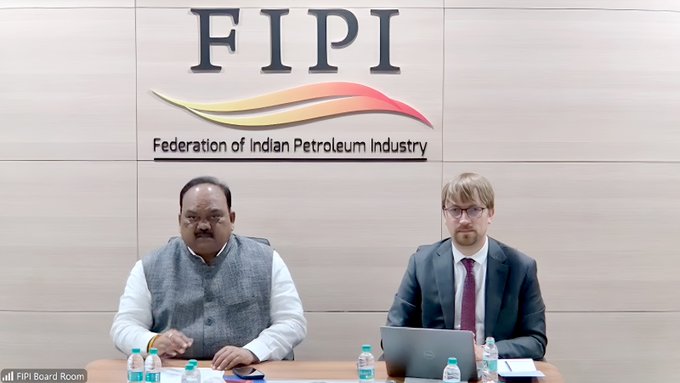
Mr. V. Satish Kumar, Director General of FIPI, extended a warm welcome to the distinguished speakers from the IEA and all participants joining the presentation on the “World Energy Outlook 2025”.
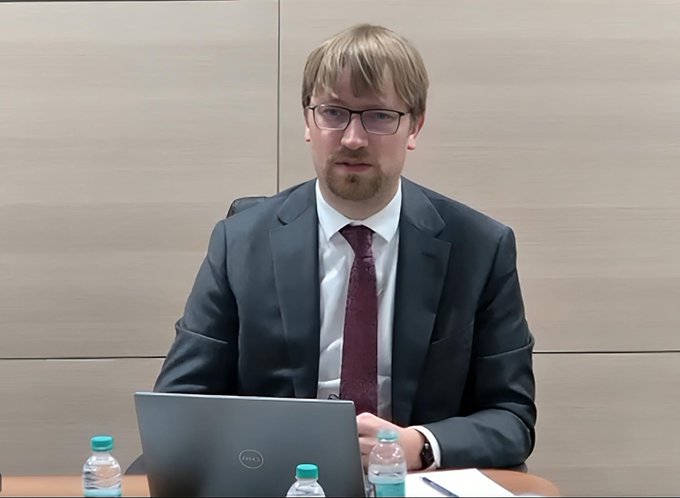
Dr. Peter Zeniewski, Senior Analyst at the IEA, delivered an insightful presentation on World Energy Outlook 2025, offering valuable perspectives on the evolving global energy landscape.
04-December-2025
Mr. V. Satish Kumar, Director General, FIPI, commenced the session with his opening remarks by extending a warm welcome to all participants, including representatives from the International Energy Agency, and officials from the Indian oil and gas industry. He expressed his privilege in hosting the session on the World Energy Outlook 2025, and introduced the keynote speaker, Dr. Peter Zeniewski, Senior Energy Analyst at the IEA.
DG, FIPI highlighted Dr. Zeniewski’s distinguished professional background, mentioning his previous role as a Chancellor’s Fellow at the University of Edinburgh, as well as his experience with the European Commission and Wood Mackenzie. He also mentioned that Dr. Zeniewski holds a Ph.D. in International Relations from the University of Oxford.
Emphasizing the significance of the session, he expressed confidence that the presentation would provide valuable insights to industry stakeholders, particularly those engaged in the gas and LNG sectors. He conveyed his sincere appreciation to the IEA team and extended special thanks to Dr. Zeniewski for agreeing to make presentation and invited Dr. Zeniewski to deliver the same.
Dr. Peter Zeniewski commenced his presentation by expressing his gratitude to Mr. V. Satish Kumar, Director General, FIPI, and thanked all participants for their presence, both physically and virtually. He conveyed that it is a great honour to address such a distinguished gathering and expressed his appreciation for the opportunity to share insights from the recently released World Energy Outlook.
He mentioned that the report has been published at a time marked by significant geopolitical tensions, uncertainties in global trade conditions, and an ongoing realignment of energy flows shaped by evolving political relationships. In this context, he highlighted that the global energy landscape is increasingly uncertain, and the International Energy Agency strives to model and analyse these complexities through its annual outlook.
Dr. Zeniewski further mentioned that he would begin by outlining the key findings of the report, before delving deeper into the outlook for natural gas. He emphasized that the gas sector is currently witnessing considerable activity, with growing discussions around its role in the energy transition, as well as near-term developments. In particular, he pointed to the significant wave of new LNG supply expected to come online in the coming years and underscored that understanding how this additional supply will be absorbed by the market remains a critical aspect of the analysis.
He concluded his introductory remarks by indicating that he would support his presentation with a set of slides highlighting these key themes. Dr. Zeniewski then elaborated on the analytical framework of the World Energy Outlook, emphasizing that it is built on four distinct scenarios, none of which are intended as forecasts. Instead, these scenarios are designed to explore possible future pathways based on current policy settings, technological trends, and cost structures. He explained that the “Stated Policies Scenario” reflects a dynamic interpretation of existing and announced policy intentions, while the “Current Policies Scenario” takes a more conservative view, considering only enacted policies and existing constraints. In addition, two normative scenarios, the Net Zero Emissions by 2050 scenario and the Energy Access scenario, work backwards from defined global goals, such as limiting temperature rise to 1.5°C and achieving universal access to electricity and clean cooking. Together, these scenarios provide a comprehensive framework to understand the evolving global energy landscape under varying assumptions.
He further highlighted that despite differences across scenarios, certain structural trends remain consistent. Global energy demand continues to be driven by economic growth, population expansion, and rising living standards, with a notable shift towards service-oriented economies. This transition is leading to a greater reliance on electricity as a primary energy carrier. While population growth is slowing in countries such as China, resulting in shifting demand patterns, emerging economies such as India are expected to become the primary drivers of future energy demand growth. Rising incomes and urbanization are also increasing the demand for appliances, air conditioning, transportation, petrochemicals, and data centres, all of which contribute significantly to energy consumption. These factors collectively reinforce the growing importance of electricity in meeting future energy needs.
A key finding of the outlook, as highlighted by Dr. Zeniewski, was the rapid emergence of the “age of electricity.” Electricity demand is projected to grow faster than overall energy demand across all scenarios, driven by electrification in transport, industry, and buildings, as well as the expansion of digital infrastructure such as data centres. Advanced economies are witnessing a resurgence in electricity demand, while emerging markets are experiencing strong growth due to cooling needs and increasing electrification. He noted that in countries like India, cooling alone could account for a substantial share of electricity demand growth. At the same time, natural gas continues to play a significant role in meeting incremental electricity demand, particularly in regions like the United States, where gas and nuclear energy are expected to support the rapid rise in data centre consumption.
Turning to natural gas and LNG markets, Dr. Zeniewski observed that global gas demand has shown resilience despite recent geopolitical disruptions, with strong growth led by emerging markets in Asia. However, future trajectories vary across scenarios, ranging from continued growth to eventual stabilization. On the supply side, he underscored the critical need for sustained investment, as natural decline rates in existing fields could significantly reduce supply without continuous capital infusion. He also highlighted the unprecedented expansion of LNG capacity, led by the United States, Qatar, and Australia, which is expected to create a substantial supply wave in the coming years. This surge is likely to exert downward pressure on prices, benefiting importing countries such as India and Southeast Asian nations. However, the key challenge remains the absorption of this additional supply, which will depend on price dynamics, regional demand patterns, and the pace of energy transition.
Dr. Peter Zeniewski subsequently led an engaging Q&A session, wherein he thoughtfully addressed the queries raised by participants. He provided detailed clarifications and shared valuable insights on the various issues discussed during the interaction. His responses reflected deep expertise and offered greater clarity on key aspects of the presentation, enriching the overall deliberations.
Mr. Deb Adhikari, Director (E&P), FIPI, in his concluding remarks, expressed his sincere gratitude to Dr. Peter Zeniewski and IEA team for taking the time to share their valuable perspectives with the participants. He also extended his appreciation to all attendees who had joined the session.
Further, he mentioned that the session marked a meaningful exchange of insights and emphasized FIPI’s intent to continue organizing such engagements with leading global organizations in the future for the benefit of members and industry stakeholders.
He concluded by formally closing the session and thanking everyone once again for their participation.

Webinar on Consultation paper on “Framework for Leasi..
Global Energy Leadership Dialogue - 'Energy Security Re..
Webinar on Recent Judicial Developments in Internationa..
Webinar on API Low Carbon Standards ..
14th Annual Convention of FIPI Student Chapters ..
Webinar on Oilfield Equipment Leasing- a permissible ac..
Webinar on “LNG at the Crossroads: Fundamentals and P..
Webinar on An overview of API standardization and certi..
FIPI Post Budget Analysis 2026..
FIPI Annual Awards 2024-25- A Glimpse of Winners..