
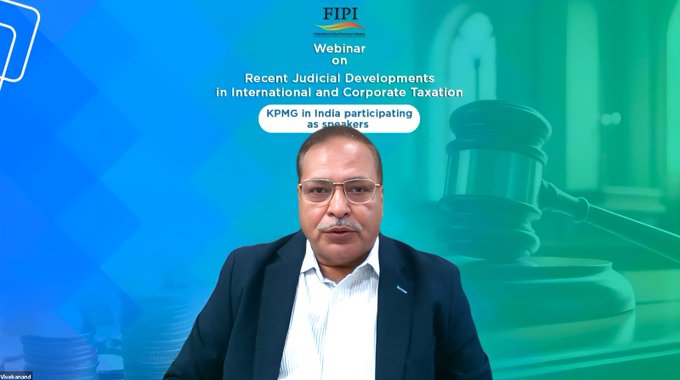
Mr. Vivekanand, Director (Finance, Taxation & Legal), FIPI, delivered the opening remarks by warmly welcoming the distinguished speakers from KPMG India and all participants joining the webinar on "Recent Judicial Developments in International and Corporate Taxation."

During the webinar, eminent speakers Mr. Himanshu Sikka, Partner, KPMG India; Ms. Nidhi Kansal, Partner, B S R & Co. LLP; and Ms. Nidhi Bansal, Associate Director, B S R & Co. LLP delivered an insightful and comprehensive presentation on the evolving landscape of international and corporate taxation.
15-June-2026
Mr. Vivekanand, Director (Finance, Taxation & Legal), FIPI began the session with the opening remarks. He said that this is the first time that FIPI is organizing a webinar focused specifically on recent judicial tax decisions. He said that while we have regularly conducted sessions on changes in tax laws and rules, judicial pronouncements are equally important as they significantly influence tax positions and business decisions. He said that, in day-to-day operations, important judicial rulings may sometimes go unnoticed, even though they can have a substantial impact on tax planning, tax savings, compliance obligations, and potential tax exposures. He further said that the topic of webinar is particularly relevant as many FIPI member companies have expanded their global presence and are engaged in cross-border operations. The session covers important judicial decisions relating to international taxation, permanent establishment (PE), double taxation avoidance agreements (DTAAs), corporate guarantees, and other key tax issues. Understanding these rulings will help organizations make informed decisions, assess tax risks more effectively, and structure their transactions in a tax-efficient and compliant manner.
Mr. Himanshu Sikka, Partner, Indirect Tax and Tax Incentives Practice at KPMG India highlighted, that the subject of webinar is highly relevant in the current business environment. Recent judicial pronouncements in international taxation are reshaping the landscape of tax certainty, dispute resolution, and cross-border investment structures. He said that these rulings have significant implications for how businesses manage tax risks, interpret treaty provisions, and structure their global operations.
Ms. Nidhi Kansal, Partner in B S R & Co LLP and Ms. Nidhi Bansal, Associate Director in B B S R & Associates LLP then discussed about the five significant recent tax rulings and their implications for multinational companies, cross-border transactions, financing structures, and treaty benefits.
The Court examined whether Hyatt UAE had a Permanent Establishment (PE) in India. Although the UAE entity claimed that it only provided strategic oversight services and did not have a fixed place of business in India, the tax authorities noted frequent visits by expatriate employees, significant involvement in hotel operations, and a revenue-linked remuneration model. Based on the overall facts, the Supreme Court held that Hyatt UAE effectively exercised operational control and had a Fixed Place PE in India. The Hyatt International ruling shows that tax authorities and courts will focus on the actual conduct of business rather than contractual wording. Although Hyatt UAE claimed that it only provided strategic oversight, frequent visits by its employees, operational involvement, and revenue-linked compensation led the Supreme Court to conclude that it had a Permanent Establishment (PE) in India. For oil and gas companies with cross-border operations, the ruling highlights the need to clearly separate advisory functions from operational control, maintain strong documentation, and carefully manage employee activities and group support arrangements.
The Chennai Tribunal's decision in the Vestas Wind Technology case deals with the applicability of Section 94B and the protection available under the Non-Discrimination Clause of the India-Denmark DTAA. Section 94B restricts the deduction of interest paid on loans from non-resident associated enterprises to 30% of EBITDA, with the excess interest being disallowed and carried forward for up to eight years. The Chennai Tribunal held that Section 94B interest disallowance cannot apply where it violates the Non-Discrimination Clause of the India-Denmark DTAA. Since interest paid to non-residents was being treated less favourably than interest paid to residents, the Tribunal deleted the entire disallowance. Therefore, it was mentioned that companies with ECBs from countries having similar Treaty provisions should explore relief from Section 94B disallowances and potentially reduce their tax burden.
The Delhi High Court held that when a company buys back its own shares at a price lower than Fair Market Value (FMV), the difference between FMV and the buyback price cannot be taxed under Section 56(2)(x). The Court ruled that a buyback is essentially a reduction of share capital, not an acquisition of property, because the shares are extinguished and cease to exist after the buyback. Thus, it was mentioned that companies can undertake buybacks below FMV without attracting tax under Section 56(2)(x), providing strategic restructuring transactions.
These cases deal with the taxability of guarantee fees charged by foreign parent companies to their Indian subsidiaries for providing corporate guarantees on loans.
The Tiger Global case dealt with the availability of capital gains exemption under the India–Mauritius DTAA. The Supreme Court denied treaty benefits, holding that tax authorities can look beyond the structure of a transaction and examine whether it was designed primarily for tax avoidance. The most significant takeaway is that a Tax Residency Certificate (TRC) alone is no longer sufficient to claim treaty benefits. Tax authorities can examine the commercial substance, purpose, and economic activities of the entity claiming treaty protection.
Lastly, Mr. Vivekanand gave the closing remarks and thanked the KPMG team for sharing these important judicial developments. He said that the decisions discussed have significant implications for companies, particularly in relation to cross-border transactions, support arrangements with foreign partners and joint ventures, treaty benefits, and financing structures. He also thanked all participants for their active participation.

Webinar on Consultation paper on “Framework for Leasi..

Global Energy Leadership Dialogue - 'Energy Security Re..

Webinar on Recent Judicial Developments in Internationa..

Webinar on API Low Carbon Standards ..

14th Annual Convention of FIPI Student Chapters ..

Webinar on Oilfield Equipment Leasing- a permissible ac..

Webinar on “LNG at the Crossroads: Fundamentals and P..

Webinar on An overview of API standardization and certi..
FIPI Post Budget Analysis 2026..

FIPI Annual Awards 2024-25- A Glimpse of Winners..